AI Automation for MedSpas (2026 Growth & Booking System Guide)
Most MedSpas believe their growth problem is lead generation. It rarely is. It is conversion discipline.
I have seen the same pattern across clinics in the USA, Canada, and Europe: the ads are running, the Instagram page looks polished, the treatments are in demand, and the owner still feels like growth is inconsistent. On paper, the clinic has demand. In reality, the revenue engine is leaking at every stage. Calls go unanswered after hours. DMs sit too long. Website leads fill a form and wait. Follow-up depends on whoever is free at the front desk. Rebooking is reactive instead of systematic.
That is why AI Automation for MedSpas matters in 2026. Not because it sounds modern, but because it solves the operational gap between interest and booked revenue. When I build these systems, I am not adding random tools for the sake of it. I am engineering a conversion layer: AI chat agents, AI voice agents, CRM workflows, automated reminders, loyalty sequences, and reporting infrastructure that turns attention into appointments and appointments into lifetime value.
This guide breaks down how I think about medspa growth systems, what the market is doing now, how to get leads for your MedSpa, how an AI booking system actually works, and what a practical implementation looks like when I deploy it for clients. If you are serious about building a clinic that scales without operational chaos, this is the model.
Why Most MedSpas Are Bleeding Revenue Without Knowing It
The biggest revenue leak in most MedSpas is not demand. It is response failure.
A potential client sees your reel, clicks your ad, visits your website, or sends a message after work hours. They are not conducting academic research. They want clarity, reassurance, price range context, and a fast next step. If they do not get it immediately, they move on. That decision is brutal, invisible, and expensive.
Lead response research has been saying this for years. The Lead Response Management study found that contacting a lead within five minutes makes you dramatically more likely to connect and qualify than waiting longer. Leads called within five minutes are 100 times more likely to be contacted and 21 times more likely to qualify than leads contacted after 30 minutes.
Now apply that to a MedSpa. Your front desk is already juggling calls, walk-ins, providers, reschedules, retail, and treatment questions. Even good teams become inconsistent under volume. That inconsistency creates silent loss. Leads are not marked as lost in a dramatic way. They just cool off, compare other clinics, or book somewhere else.
In practice, I usually see four common leaks. First, missed calls after hours. Second, delayed replies to website or social inquiries. Third, weak qualification that produces low-show consultations. Fourth, poor rebooking and post-treatment follow-up.
This is exactly where AI Automation for MedSpas becomes commercially important. It is the missing response layer. An AI chat system can engage instantly on your website, Instagram, or WhatsApp. An AI voice agent can answer calls when staff are unavailable. Your CRM can trigger the right confirmation, nurture, reminder, and reactivation sequence without anyone remembering to do it. The point is not to replace your team. The point is to make sure no serious inquiry dies in silence.
The MedSpa Market in 2026: Why Now Is the Inflection Point
The timing matters. This is not a niche side category anymore. The market is expanding fast, competition is increasing, and consumer expectations are getting harder to satisfy with manual processes.
Grand View Research reports the global medical spa market was valued at $21.21 billion in 2024 and is projected to reach $78.23 billion by 2033, growing at a 15.77% CAGR from 2025 onward. Separate 2026 market coverage cites the sector growing from $20.08 billion in 2025 to $22.41 billion in 2026.
That growth attracts more operators, more ad spend, more consolidation, and more noise. It also means the clinics that win will not simply be the ones offering good treatments. They will be the ones with better systems.
Financially, MedSpas remain attractive businesses when managed well. Recent industry benchmarks place gross margins around 60% to 70% and healthy net margins around 15% to 25% for established operators. But those margins are only real if conversion, retention, and operational efficiency are real.
At the same time, the consumer is changing. Younger audiences are entering the category earlier, often with preventative aesthetics in mind rather than correction-only treatment plans. Preventative Botox, subtle enhancement, regenerative treatments, and lower-downtime options continue to expand. Trend reporting for 2026 also shows clear momentum around GLP-1-related aesthetic demand, wellness-aesthetic convergence, AI-driven personalization, and minimally invasive treatments.
That combination creates an inflection point. Demand is rising. Attention spans are shortening. Expectations are digital-first. If your clinic still relies on manual callbacks, memory-based follow-up, and disconnected tools, you are trying to win a 2026 market with 2018 infrastructure.
How to Get Leads for Your MedSpa (The AI-First Approach)
If you are asking how to get leads for your MedSpa, the direct answer is this: build a system that captures, qualifies, and books intent across every channel where prospects already show up.
That means your lead generation model should not depend on one source. It should combine demand creation and demand capture.
I usually structure it in layers. The first layer is performance marketing. Meta Ads create demand and awareness. Google Ads capture intent when someone is actively searching for a treatment, provider, or clinic nearby. The second layer is local discovery: local SEO, Google Business Profile optimization, service pages, treatment pages, and review velocity. The third layer is response automation: AI chat on the website, AI chat on social channels, and AI voice handling for inbound calls. The fourth layer is conversion infrastructure: CRM pipelines, follow-up workflows, reminders, and reactivation campaigns.
The reason most MedSpas underperform is that they obsess over traffic before fixing response speed. I would rather improve your conversion rate on current lead volume than blindly increase ad spend. If your clinic is already getting inquiries but responding slowly or inconsistently, you do not have a lead shortage. You have a system shortage.
An AI-first lead generation model changes that. A website visitor gets an immediate conversation instead of a dead contact form. An Instagram inquiry gets qualified instead of parked in a crowded inbox. A caller after business hours gets answers, reassurance, and a booking option instead of voicemail. Every interaction is pushed into the CRM, tagged, and routed into the right workflow.
This is where my build stack matters. I typically use GoHighLevel for CRM and funnel orchestration, Vapi and Twilio for AI voice workflows, Make.com or n8n for automation logic, and OpenAI-based prompt systems to make the conversations useful rather than robotic. When done properly, these tools do not just collect leads. They increase the percentage of existing attention that turns into consultations.
For MedSpas, better lead generation in 2026 is not just more reach. It is faster response, smarter qualification, and less friction from inquiry to booking.
How to Attract Customers to Your Spa: The Modern Playbook
If you want to attract customers to your spa, you need to combine authority, trust, and convenience.
Attraction starts long before someone fills a form. A MedSpa prospect is evaluating outcomes, credibility, safety, aesthetics, and price sensitivity at the same time. That is why content still matters. Before-and-after proof, provider education, treatment explainers, myth-busting reels, and location-based trust signals all influence conversion upstream.
But attraction is not only content. It is also proof. Review management is one of the highest-leverage assets in this category because prospective clients do not buy treatments in a vacuum. They buy certainty. Automated review requests, reputation workflows, and testimonial capture systems create that certainty at scale.
I also like applying a simple 3-3-3 lens to MedSpa marketing. Pick three core messages — for example: natural-looking results, minimal downtime, and trusted clinical care. Then map them to three audience segments — for example: preventative clients in their late 20s and 30s, rejuvenation-focused women 40+, and men exploring aesthetics for the first time. Then distribute those messages through three primary channels such as Instagram, Google Search, and email/SMS nurture. The framework keeps the marketing focused instead of chaotic.
The critical point is this: attraction without conversion infrastructure is wasted spend. I have seen MedSpas with strong branding and decent content still underperform because nobody engineered what happens after someone raises a hand. When your attraction engine is paired with AI chat, CRM automation, booking workflows, and reactivation sequences, the top of funnel stops behaving like a vanity exercise and starts behaving like a revenue system.
How to Promote a Med Spa in 2026
Promoting a med spa in 2026 requires channel strategy and system discipline.
For awareness, Meta remains powerful because aesthetic services are visual and emotionally driven. Reels, short-form transformations, provider-led education, and localized creative can produce strong top-of-funnel demand when the offer is positioned correctly. For intent capture, Google Search matters because many consumers are already looking for a service, a problem solution, or a clinic in a specific city. Meta creates interest. Google captures active demand.
But promotion does not stop at ad delivery. It has to be connected to retargeting, follow-up, and CRM segmentation. Someone who clicks an ad and does not book should not disappear. They should enter a nurture sequence. Someone who starts a chat and hesitates should receive the right follow-up. Someone who had a consultation but did not convert should be reactivated based on treatment category, objection, and timing.
Cross-platform consistency matters as well. Your Instagram, TikTok, Google profile, website, landing pages, and front-desk script should all sound like the same business. Too many MedSpas have polished ads and weak operational handoff. That disconnect kills ROI.
I also see strong results when promotion is layered with local event strategy, in-clinic offers, referral campaigns, and selective influencer or UGC partnerships. Not every influencer campaign is worth doing. But when the content is credible, localized, and tied to a real booking funnel, it can work.
The operational truth is simple: promotion only becomes revenue when it is connected to a booking system. That is why I treat paid acquisition and CRM architecture as one integrated problem, not two separate departments.
The AI Booking System: How It Actually Works
This is the part most people get wrong. They think AI booking means adding a chatbot and hoping it helps. It does not work that way. A real medspa booking system is an architecture.
A lead lands on your website, sends a DM, clicks a paid ad, or calls after hours. Instead of waiting for staff intervention, the system responds instantly. If the lead comes through text-based channels, an AI chat agent engages immediately. If the lead calls, an AI voice agent answers, understands intent, and keeps the conversation moving.
The agent does not just say hello. It qualifies. It asks what treatment the person is interested in, whether they are a first-time client, what concern they want to address, what timeframe they are considering, and in some cases a useful budget or eligibility signal. The objective is not interrogation. The objective is relevance.
Once qualified, the system presents the next best action. That may be booking a consultation directly into GoHighLevel, Calendly, or another calendar environment. It may be routing the person to a provider-specific consult type. It may be escalating to a human if the conversation becomes clinically sensitive or requires discretion beyond automation rules.
After the booking is placed, the system handles confirmation by SMS and email. Then the pre-appointment sequence begins. I typically include reminders, basic expectation setting, provider introduction, directions, preparation instructions, and light social proof. This reduces no-shows and increases arrival quality.
After the appointment, the system should not go silent. Post-visit workflows can trigger review requests, check-ins, treatment education, rebooking prompts, loyalty messaging, or referral campaigns. If the person did not book after consult, they should enter a follow-up workflow. If they did book treatment, lifecycle automation should continue.
Everything feeds into the CRM. That means source attribution, inquiry status, show rate, close rate, provider performance, rebooking behavior, and campaign ROI can actually be measured. This is why I often recommend a combination of GoHighLevel, Twilio, Vapi, Make.com, n8n, and OpenAI-based prompt orchestration. Each tool has a job. The value is in the system design.
A properly implemented AI booking system eliminates the biggest medspa revenue leaks: missed calls, delayed response, inconsistent qualification, no-show exposure, and weak rebooking. It does not replace hospitality. It protects revenue so your team can focus on actual patient experience.
Relevant services: AI Automation · AI Voice Agents · AI Chat Agents · CRM Consulting · GoHighLevel · Funnel Automation · Performance Marketing
Can ChatGPT Generate Leads for Your MedSpa?
Not by itself.
ChatGPT is a language model. It is not a lead generation machine in isolation. It does not buy media, answer your phone, update your CRM, or place appointments on your calendar unless it is integrated into a system that does those things.
That said, when I use OpenAI or GPT-based models inside a proper operational stack, they absolutely help generate and qualify leads. The model becomes the conversational intelligence layer inside an AI chat agent, an AI voice agent, a lead qualification workflow, a website assistant, or a reactivation engine.
That distinction matters. ChatGPT is the brain. Your CRM, automations, calendar, tracking, and channel integrations are the body.
For a MedSpa, I can train GPT-powered chat systems around your actual service menu, FAQs, objection handling, consultation logic, provider positioning, and booking rules. That gives the prospect a useful, branded interaction instead of a generic bot experience. But the commercial result only happens when the workflow is connected end to end.
This is exactly why I separate AI tools from AI systems. Tools answer. Systems convert.
Relevant: AI Chat Agents →
What Is the 5-Minute Rule for Leads?
The 5-minute rule for leads says that if you respond to a new inquiry within five minutes, your chances of contacting and qualifying that lead rise dramatically compared with waiting longer. The research most often cited here shows that responding within five minutes can make you 100 times more likely to connect and 21 times more likely to qualify than waiting 30 minutes.
For MedSpas, this rule is not a nice operational guideline. It is revenue math.
The reason AI matters so much is that it effectively turns the five-minute rule into a five-second system. Website chat responds instantly. Voice AI can answer missed or after-hours calls immediately. CRM workflows can send confirmations and next steps the moment someone inquires. Once you do that consistently, you stop losing high-intent prospects to silence and delay.
What Is the 3-3-3 Rule in Marketing?
The 3-3-3 rule in marketing is a simple focus framework: define three key messages, target three core audience segments, and execute through three primary channels.
For a MedSpa, that might mean messaging around natural-looking results, minimal downtime, and trusted provider care. Your three segments might be preventative clients, rejuvenation clients, and male aesthetics clients. Your three channels might be Instagram, Google Search, and email/SMS nurture.
The reason I like this framework is that it forces strategic clarity. Most MedSpa marketing underperforms because the brand tries to say too much to too many people in too many places. AI automation then helps you execute the framework at scale by personalizing the right message to the right segment across the right channel without relying entirely on manual effort.
How Profitable Is a Med Spa? (2026 Numbers)
A well-run med spa can be highly profitable, but profitability is not automatic.
In market terms, the category is large and expanding. Coverage for 2026 places the global market at roughly $22.41 billion, while longer-range projections place it near $78.23 billion by 2033. Operationally, the more useful numbers are margin and efficiency benchmarks. Recent medspa finance benchmarks place gross margins around 60% to 70% and healthy net margins around 15% to 25% for established businesses.
Average annual revenue benchmarks vary by size, geography, service mix, and maturity, but industry reporting has placed average medspa revenue in the roughly $1.4M to $2.0M range in recent years.
The four levers I care about most are booking conversion rate, rebooking rate, average ticket value, and operational efficiency. AI automation improves all four. It increases speed-to-lead, reduces missed inquiries, improves show rates through reminders, and creates more systematic reactivation and loyalty motion. That is why high-performing clinics increasingly treat automation as part of profitability strategy, not just admin convenience.
What Aesthetics Will Be Popular in 2026?
The aesthetics categories gaining the most momentum in 2026 point in one direction: personalized, lower-friction, outcomes-driven care.
Regenerative aesthetics continue to expand, including exosome-related conversations, PRP-linked positioning, and collagen-supporting treatment narratives. Minimally invasive body contouring and skin tightening remain strong because clients want visible outcomes without major downtime. Preventative aesthetics also continue to grow, especially among younger clients who are interested in maintenance, subtle enhancement, and early intervention rather than dramatic correction. Trend coverage also shows clear momentum around GLP-1-adjacent aesthetic demand, particularly skin tightening and reshaping support after weight loss. Wellness and aesthetics are converging further through IV therapy, hormone-related support, and broader inside-out treatment positioning.
The business implication is important. MedSpas that can identify trend demand early and build dynamic campaigns around it will outperform slower operators. That is another place AI systems help: faster landing page deployment, segmented follow-up, smarter FAQ handling, and promotional sequencing tied to emerging treatment demand.
How to Run a Successful Med Spa in 2026
Running a successful med spa in 2026 is less about hustle and more about systems.
You need strong providers, good patient experience, and credible treatment outcomes. But that is the baseline. The businesses that scale now are the ones that operationalize consistency. That starts with the front desk. If the clinic misses calls, delays replies, or treats follow-up as optional, growth becomes unstable. An AI-powered front desk layer solves a lot of that by ensuring no inquiry goes unanswered simply because staff were busy.
The second requirement is CRM discipline. I generally recommend a CRM environment like GoHighLevel when the goal is to unify inquiries, nurture, booking workflows, pipeline visibility, reminders, and post-visit lifecycle automation. Without a central system, you cannot reliably track cost per lead, cost per acquisition, rebooking rate, treatment conversion, or lifetime value.
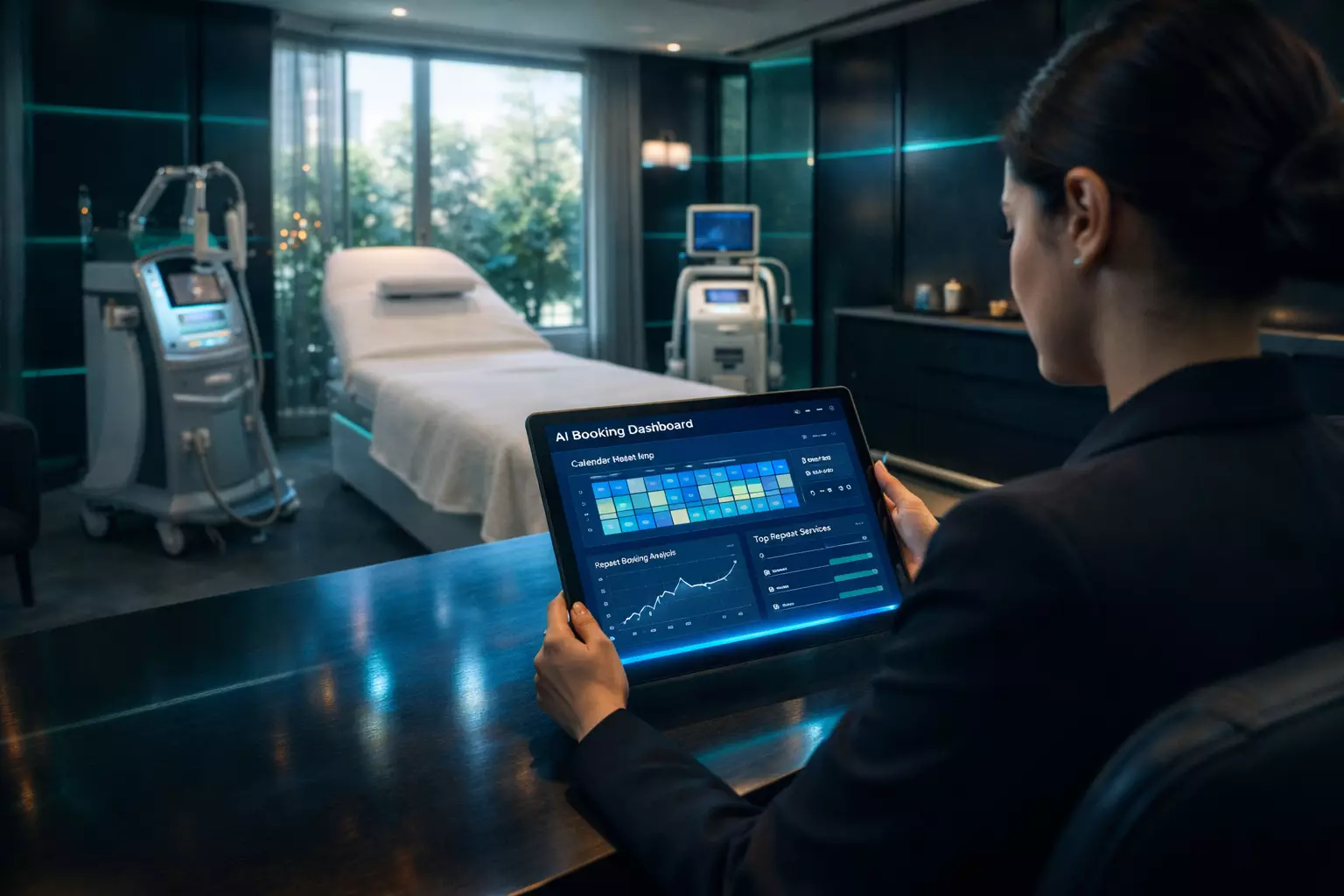
The third requirement is data-driven management. Too many clinics still make decisions based on vibe. A real med spa growth system tracks where leads come from, how quickly they were answered, what percentage booked, who showed up, what converted, what rebooked, and which campaigns actually produce profitable patients. When I build dashboards, the point is not reporting for the sake of reporting. It is better decision-making.
The fourth requirement is intelligent staff augmentation. AI should handle repetitive, time-sensitive, and structured communication. Your team should focus on care, reassurance, treatment quality, and relationship depth. That division of labor increases both efficiency and patient experience.
The fifth requirement is reputation and retention infrastructure. Reviews, reminders, reactivation campaigns, loyalty flows, and referral systems should not be occasional tasks. They should be embedded.
And yes, compliance matters. MedSpas operating in the USA, Canada, UK, and Europe need to think carefully about privacy, consent, platform policy, and appropriate boundaries between automation and clinical judgment. AI should support operational communication, not casually improvise medical advice.
Relevant: CRM Consulting · AI Automation
Implementation Framework: How I Build MedSpa Growth Systems
When I build AI Automation for MedSpas, I do not start with software demos. I start with leakage.
Phase 1 — Revenue Audit (48 hours): I review current lead flow, response timing, missed call exposure, funnel structure, CRM state, appointment logic, nurture gaps, rebooking behavior, and reporting blind spots. The goal is to identify where revenue is currently being lost.
Phase 2 — System Design: I map the operating blueprint. That includes CRM architecture, AI chat logic, AI voice logic, funnel routing, source attribution, reminder systems, review automation, reactivation strategy, and dashboard requirements. This is where tool selection becomes practical rather than fashionable.
Phase 3 — 30-Day Build Sprint: This is the deployment phase. Core systems go live: AI chat agent, AI voice agent, booking automation, follow-up workflows, pipeline configuration, no-show prevention sequences, and the key reporting layer. In many cases, the clinic starts seeing operational relief almost immediately because response speed improves fast.
Phase 4 — Scale & Optimize: Once the system is live, we refine. We A/B test messaging, improve qualification logic, tighten nurture timing, build more segmented campaigns, and create better visibility into ROI. The system becomes sharper over time instead of decaying into chaos.
Meaningful results often show up within 30 to 60 days, but the real value is compounding. Each month, the workflow gets better, the data gets cleaner, and the clinic becomes less dependent on manual heroics.
What to Expect: Real Results from AI-Powered MedSpas
When these systems are implemented correctly, the outcome is usually not abstract. It shows up in very practical business metrics.
Across real-world deployment patterns, I typically expect to see a 20% to 40% increase in booking conversion rate once response speed, qualification, and follow-up improve. Missed calls and lost inquiries can drop materially because after-hours and overflow traffic are no longer abandoned. Automated reminders and structured pre-appointment nurture can reduce no-show rates. Rebooking and referral automation can increase lifetime value. Administrative load often drops because staff stop doing repetitive communication manually.
In broad terms, that usually looks like this: faster speed to lead, fewer dropped opportunities, better show rates, cleaner reporting, and stronger patient retention. Those are not vanity benefits. They are the mechanics of margin.
The clinics that get the most from automation are usually not the ones chasing the most tools. They are the ones willing to treat growth like an operating system.
If you want a MedSpa-specific implementation path, start here: MedSpa Industry Page →